
Navigating HOA Rules for Heat Pump Replacements in Hunters Creek
Upgrading an aging exterior unit in a strict neighborhood is rarely as simple as swapping out an old metal box. See how to satisfy your home's pre-winter heating needs while meeting ARB guidelines.
By Chris Javier
Balancing Fall Heating Upgrades with HOA Architectural Guidelines
At Chilly Billy Heating & Cooling, we frequently see homeowners whose aging exterior heat pump is running constantly, yet the house still feels uncomfortably chilly—a clear sign that navigating HOA rules for heat pump replacements in Hunters Creek is about to become a top priority. Upgrading an aging exterior unit in a strict neighborhood is rarely as simple as swapping out an old metal box for a new one. In our experience working across Kissimmee and Central Florida, homeowners face a critical decision point: selecting a replacement heat pump model and pad placement that satisfies both the home's pre-winter heating needs and the community's rigid exterior modification guidelines. Before you can secure reliable air conditioning services, you have to solve the compliance puzzle.
Proper planning is required to avoid violations related to noise generation, physical footprints, and visual aesthetics. Homeowners associations enforce these rules to maintain neighborhood harmony and property values, which means any exterior HVAC modification must pass through the Architectural Review Board (ARB). Attempting to bypass this process or assuming a contractor can simply drop a new unit on the old concrete pad often leads to costly delays, forced relocations, or formal violation notices.
The Tension Between Comfort and Compliance
As we approach the fall pre-winter heating startup, the urgency to replace a failing system increases. However, our team notes that the ARB approval process operates on its own timeline. Understanding how local regulations dictate equipment selection and placement is the first step toward a seamless upgrade. Associations look closely at how a new unit impacts neighboring properties, specifically focusing on how close it sits to the property line, how loud it operates, and whether it remains visible from the street.
Balancing these factors requires a proactive approach. By gathering the necessary technical documentation and understanding the specific constraints of your property lot, you can select a high-performance heat pump that keeps your home comfortable without triggering a dispute with your homeowners association. Additionally, upgrading to a high-efficiency model may qualify you for generally applicable energy rebates or federal tax credits, though we always advise verifying current programs with your utility provider or a tax professional.
Why High-Efficiency Heat Pumps Complicate HOA Footprint Rules
In our years of handling installations, our team has noticed that modern high-efficiency heat pumps often have larger physical dimensions than older, less efficient models. To achieve higher energy ratings and meet updated federal efficiency standards, manufacturers must use larger condenser coils to dissipate heat more effectively. This physical reality creates immediate tension with strict neighborhood aesthetic and footprint regulations.
With Central Florida's heavy year-round climate demand, robust, high-efficiency heat pumps are practically a necessity. The region's intense summer heat and damp winter cold require systems that can run continuously without excessive energy consumption. However, these bulkier units risk violating standard HOA footprint rules if not carefully selected and positioned. A homeowner cannot simply assume that a new 3-ton unit will fit on the exact same footprint as an aging 3-ton unit from fifteen years ago.
Evaluating Pad Dimensions and Relocation Needs
Homeowners must verify exact pad dimensions before committing to a specific high-efficiency model. If the new unit hangs over the edge of the existing concrete pad or encroaches on a restricted zone, the ARB will likely reject the application. Aging systems that require constant fixes might prompt an urgent upgrade, making these footprint considerations critical. If you are scheduling frequent AC repair in Hunters Creek, it is wise to start measuring your exterior space now.
Sometimes, upgrading to a modern system requires moving the equipment entirely. One local homeowner we recently worked with required a complete system upgrade alongside relocating their air handler and extensive ductwork. By providing expert suggestions and executing a clean, professional installation, our technicians successfully integrated the new, larger system into the property without violating community space restrictions. Planning for these spatial requirements early prevents compliance headaches later.
Navigating Decibel Limits and Noise Ordinances
Local noise ordinances generally restrict continuous noise crossing residential property lines, a standard strictly enforced by Hunters Creek HOAs. Because houses in master-planned communities are often built close together, a loud exterior compressor can easily disrupt a neighbor's patio or bedroom window. Associations mitigate this by capping the allowable decibel (dB) output of any newly installed mechanical equipment.
Modern variable-speed heat pumps operate at much lower decibel levels compared to older single-stage units. While a traditional system might turn on with a loud clunk and run at a constant, noisy speed, variable-speed compressors ramp up gently and operate quietly in the background. Many of these modern units run at sound levels frequently under 60 decibels—roughly the volume of a normal conversational tone.
Documenting Sound Ratings for the ARB
HOA review boards often require professional documentation of sound ratings during the application process. They will not simply take a homeowner's word that a unit is quiet; they need verified data. This is where our team steps in to provide the Air-Conditioning, Heating, and Refrigeration Institute (AHRI) certificate, which provides the standardized sound rating for the specific model you intend to install.
| Equipment Type | Typical Decibel (dB) Range | HOA Compliance Likelihood |
|---|---|---|
| Older Single-Stage Heat Pumps (10+ years old) | 72 dB - 80+ dB | High risk of neighbor complaints and ARB rejection |
| Modern Two-Stage Heat Pumps | 65 dB - 70 dB | Generally acceptable, requires AHRI documentation |
| Modern Variable-Speed Heat Pumps | 55 dB - 60 dB | Excellent compliance, easily meets strict noise ordinances |
Selecting a quieter unit prevents neighbor complaints and ensures seamless ARB approval. By submitting the AHRI sound rating certificate alongside your exterior modification request, you provide the exact proof the architectural committee needs to stamp your approval.
Property Line Setbacks and Pad Placement Strategy
Standard HOA property line setbacks for exterior HVAC units typically range from 3 to 5 feet. This means your heat pump and its concrete pad must sit a specific distance away from the boundary dividing your lot from your neighbor's. Precise pad placement is required to accommodate both the unit's expanded footprint and the mandatory setback distance.
Relocating an air handler or exterior pad requires careful measurement and often triggers additional ARB scrutiny. If your new high-efficiency heat pump is six inches wider than the old one, and your current pad is already sitting exactly on the setback line, you cannot simply let the new unit overhang. The entire pad must be poured or shifted further into your yard to maintain the required buffer zone.
Solutions for Tight Lot Lines
In spaces where traditional setbacks are impossible to meet, alternative compact solutions may be necessary. Some manufacturers produce "side-discharge" or slimline heat pumps specifically designed for zero-lot-line communities or tight side yards. These units feature a much narrower profile, blowing air horizontally rather than vertically, allowing them to fit into narrow corridors while still respecting setback rules.
If the central ductwork cannot be easily routed to a new, compliant pad location, we often recommend exploring decentralized options. A ductless mini split installation utilizes much smaller exterior condensers that can be mounted on exterior walls or tucked into tight alcoves, easily bypassing the spatial limitations that standard unitary heat pumps face in strict Hunters Creek neighborhoods.
Visual Screening Requirements for Exterior Units
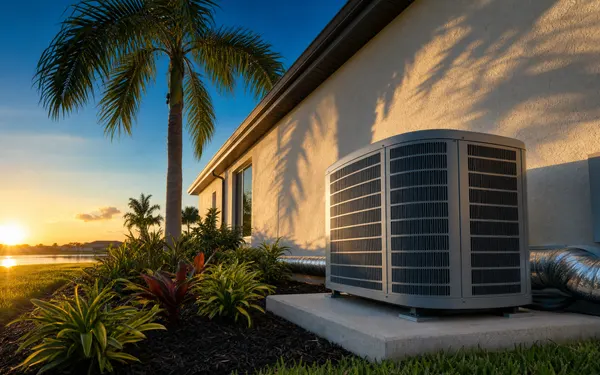
Many local associations require exterior units to be hidden from street view or neighboring properties. Even if your new heat pump meets all setback and noise requirements, the ARB may reject the installation if the equipment is deemed an eyesore. Maintaining a uniform aesthetic is a primary function of any homeowners association, and exposed mechanical equipment rarely fits that vision.
Acceptable screening methods typically include approved landscaping, structural fencing, or specialized lattice enclosures. However, screening must allow for adequate airflow to ensure the heat pump operates efficiently without suffocating the system. Heat pumps require a steady intake and exhaust of ambient air to transfer heat effectively. If a fence or dense shrubbery is placed too close to the coils, the unit will overheat, struggle to condition the home, and experience premature component failure.
Checklist for Compliant HVAC Screening
We always advise our customers to follow this simple checklist:
- Verify setback clearances: Ensure any screening material remains at least 24 to 36 inches away from the sides of the heat pump to allow for proper airflow and maintenance access.
- Check vertical clearances: Ensure there are no overhanging structures or dense tree canopies within 4 to 5 feet above the unit, as standard heat pumps exhaust air straight up.
- Select approved materials: Cross-reference your planned screening materials (e.g., white vinyl fencing, specific species of hedges, painted lattice) with the HOA's pre-approved architectural guidelines.
- Include screening in the ARB application: Do not wait until the unit is installed to figure out the screening. Include detailed screening plans in the initial exterior modification request to prevent project delays.
By proactively designing a screening solution that respects both the HOA's aesthetic standards and the equipment's airflow requirements, homeowners in Hunters Creek can avoid post-installation fines and ensure their new system operates at peak efficiency.
Preparing Your ARB Submission Before Winter Arrives
Our team at Chilly Billy Heating & Cooling typically sees review boards take 14 to 30 days to approve exterior modifications, making early submission crucial. Waiting until your current system completely fails during a cold snap leaves you vulnerable to a freezing house while you wait for committee bureaucracy to clear. Submitting your application during the fall pre-winter heating startup ensures you have ample time to secure approval and schedule the installation before severe weather hits.
A complete application must include decibel ratings, pad dimensions, setback measurements, and visual screening plans. Failing to provide exact documentation is a common error that results in denied or delayed applications. Committees rarely approve incomplete forms; they simply kick them back to the homeowner, resetting the 30-day clock.
Steps for a Successful Submission
- Request the official forms: Download the latest exterior modification or ARB request form directly from your HOA portal.
- Gather equipment specifications: Obtain the exact physical dimensions, AHRI sound rating certificates, and SEER2 efficiency documentation for the proposed heat pump model.
- Map the property lines: Sketch a site plan showing the exact distance from the proposed concrete pad to the nearest property lines, proving compliance with setback rules.
- Detail the screening method: Attach photos or drawings of the landscaping or fencing that will obscure the unit from street view.
- Submit and follow up: Turn in the complete packet and follow up with the property manager a week later to ensure it was added to the next committee meeting agenda.
Working with a professional ensures all technical specifications are accurately represented on the ARB forms. Our deep local expertise ensures the exact documentation required by the ARB is provided, smoothing the path to approval. For example, during a recent fall heating-startup project, one of our customers required an air duct extension and a new hood vent installation. Because we professionally detailed and submitted the technical specifications and ventilation needs on schedule, the project moved forward without compliance delays. Knowing the mistakes homeowners should avoid during AC installation—like skipping the ARB process—saves significant time and stress.

Partnering with Local Experts for Seamless HOA Approval
Navigating noise ordinances, pad placement, and property lines doesn't have to be overwhelming. While strict neighborhood guidelines in Hunters Creek add a layer of complexity to upgrading your exterior heat pump, the process is highly manageable when you understand what the architectural review board is looking for. The key is proactive planning, precise measurement, and verified equipment documentation.
A professional contractor helps manage the ARB approval process from equipment selection to final installation. By providing the necessary AHRI sound certificates, exact dimensional blueprints, and setback verifications, our experts take the guesswork out of your exterior modification request. Ensure your upcoming system upgrade meets all neighborhood guidelines while providing optimal comfort. When you are ready to secure a compliant, high-efficiency system, our professional HVAC and AC replacement in Hunters Creek guarantees a smooth transition from application to installation.
Frequently Asked Questions
Do I need HOA approval to replace my AC unit?
Yes, in almost all managed communities, replacing an exterior AC unit requires formal HOA approval. Because a new unit often has a different physical footprint and noise rating than the old one, the Architectural Review Board (ARB) must verify it complies with current neighborhood standards. Skipping this step can result in fines or a mandate to remove the newly installed equipment.
What is the maximum decibel level for AC units in an HOA?
While specific limits vary by community, most HOAs restrict continuous mechanical noise crossing property lines to between 60 and 70 decibels. Modern variable-speed heat pumps often operate between 55 and 60 decibels, making them an excellent choice for strict neighborhoods. Homeowners are usually required to submit an AHRI sound rating certificate to prove the new unit falls under the maximum allowed volume.
How close to the property line can a heat pump be placed?
Standard property line setbacks for exterior HVAC equipment typically range from 3 to 5 feet, depending on local municipal codes and specific HOA bylaws. The entire unit, including the concrete pad it sits on, must remain outside this buffer zone. If a new, larger high-efficiency unit encroaches on this setback, the pad must be relocated further into the homeowner's yard.
Can my HOA force me to hide my HVAC unit?
Yes, HOAs frequently enforce visual screening requirements to maintain a uniform neighborhood aesthetic. This usually means the exterior unit must not be visible from the street or the ground floor of neighboring properties. Acceptable screening methods generally include pre-approved fencing, lattice enclosures, or dense landscaping, provided they allow enough clearance for proper airflow.
What documentation does an Architectural Review Board require for a heat pump upgrade?
An ARB typically requires a comprehensive packet detailing the proposed exterior modification. This includes the manufacturer's specification sheet showing the unit's exact dimensions, the AHRI certificate verifying the decibel rating, and a site plan mapping the distance from the equipment pad to the property lines. If visual screening is required, details of the proposed landscaping or fencing must also be included.
How long does it typically take to get ARB approval for exterior HVAC modifications?
Review boards generally take between 14 and 30 days to process and approve exterior modification requests. Because committees often meet only once or twice a month, submitting an incomplete application can reset this timeline, causing significant delays. This is why our team advises homeowners to begin the approval process well before their current system completely fails.
About the author

Chris Javier
Owner & License Holder
Chris is the Owner and license holder of Chilly Billy Heating & Cooling, bringing more than a decade of hands-on HVAC experience and a knack for solving the problems other folks couldn't crack. A devoted husband and dad, he treats every home like his own, right down to the smallest detail.
Recent Articles